A STEM lab is a space in a school where students learn science, technology, engineering and maths by building things that work: a circuit that lights up, an alarm that sounds when water rises, a robot that stops before it hits a wall. It is different from a science lab, where students repeat an experiment that has a known answer. In a STEM lab they design something, test it, and fix it when it doesn't work.
That's the easy part. The harder part is that plenty of STEM labs go quiet after the first term. The room and the kits arrive. The timetable, the training and the curriculum don't.
We set up 8 labs in one district, Wardha in Maharashtra, with the state government, and trained Zilla Parishad (district council) school teachers there. This guide covers what a STEM lab is, what goes into one, and what keeps it in use.
Build, test, fix
What students do in a STEM lab
4 parts
Kits, curriculum, a lesson platform, trained teachers
40 minutes
One project, start to finish, in one period
Grade 4
When coding, and a computer, comes in
On this page: What a STEM lab means · STEM lab vs science lab, ATL and skill lab · What goes into a STEM lab · A period in a STEM lab · The new CBSE AI curriculum · Why labs go quiet · Who this is for · FAQ
What does STEM lab mean?
STEM stands for science, technology, engineering and maths. A STEM lab is a room, or a set of kits, where students learn those four subjects together by making something that has to work. The point is not the equipment. It's the cycle of building, testing and fixing.
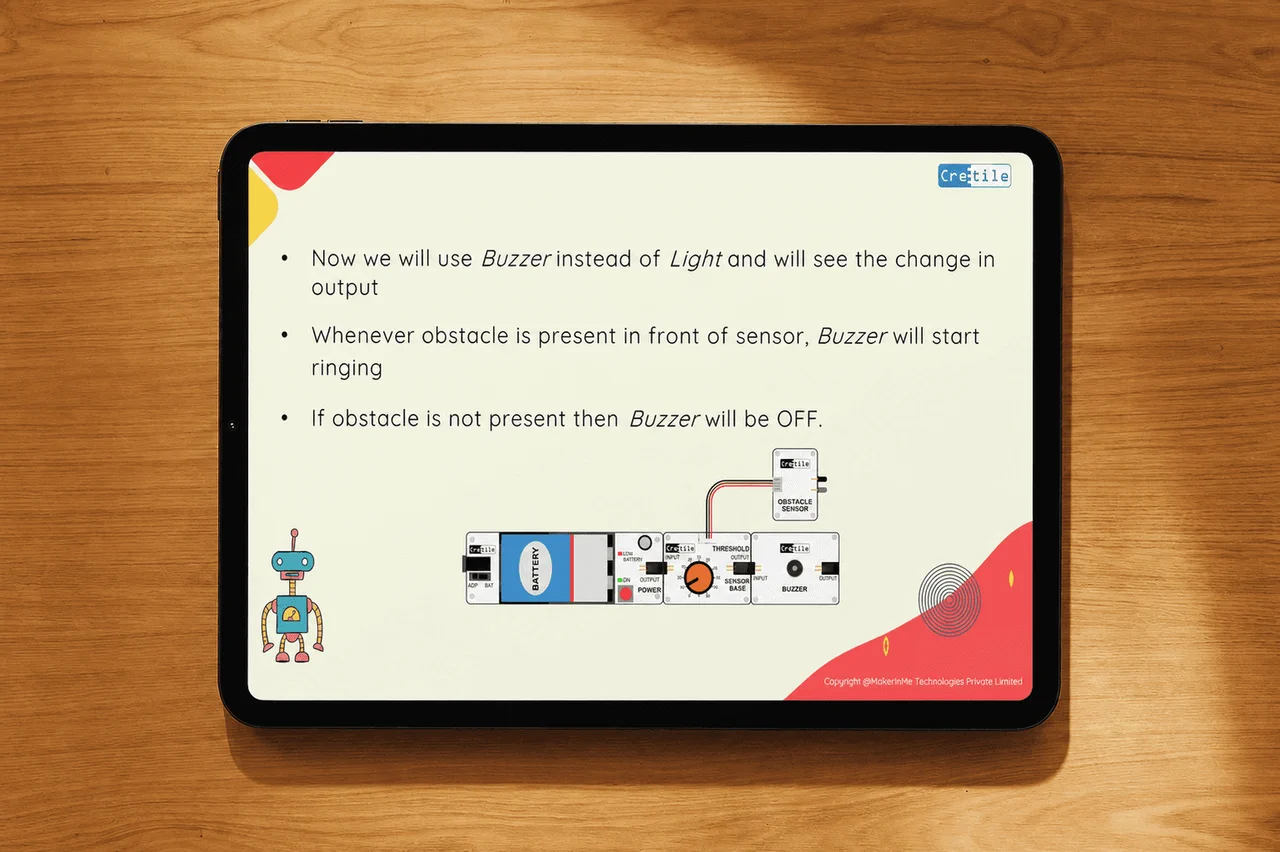
Take a water level alarm. A student connects a water sensor to a buzzer, pours water into a cup, and listens. If the buzzer stays quiet, something is wrong, and finding out what is the lesson. Science (water conducts), technology (the sensor), engineering (the circuit) and maths (where to place the sensor) all turn up in one 40-minute task.
That's why we think of STEM as an approach, not a subject. When a school treats it as one more period on the timetable, with a separate syllabus nobody connects to science or maths, the lab ends up as a reward room for good behaviour.
How is a STEM lab different from a science lab, an ATL or a skill lab?
A science lab checks a known result. A STEM lab builds something new. An Atal Tinkering Lab and a Composite Skill Lab are specific government and CBSE programmes with their own rules. Indian schools hear all of these names, often in the same month, so here is the difference in one line each.
- Science lab: students follow a procedure and confirm a result the textbook already states, such as testing for starch.
- STEM lab: students design, build and debug a working thing. There's no single right answer, only one that works.
- Atal Tinkering Lab (ATL): a tinkering lab funded under the Atal Innovation Mission (AIM) of NITI Aayog. Schools that are selected receive a grant and buy equipment against a set package list. See AIM's Atal Tinkering Labs page.
- Composite Skill Lab: a room CBSE requires every affiliated school to set up by 22 August 2027, where students from Class 6 to 12 learn skill subjects by doing them. Our Composite Skill Lab requirements guide has the full rules.
- Robotics lab: a STEM lab that focuses on robots and coding.
- Maths lab: a room with manipulatives (hands-on objects) for maths concepts, such as fraction strips and geometry models.
A STEM lab is the broad idea. An ATL is one way the government funds it. A Composite Skill Lab is a separate CBSE requirement that a STEM lab doesn't replace.
We're India's first organisation certified as an OEM (original equipment manufacturer) on GeM, the government's e-marketplace, across all ATL categories by NITI Aayog. That covers ATAL Packages 1, 2, 3, 4, 5, 6 and 8.
What goes into a STEM lab?
A STEM lab needs four things: kits students can build with, a curriculum mapped to class periods, a platform where teachers find each lesson, and teachers who have been trained to run it. Furniture and storage matter too, but a lab rarely fails because of tables.
| Part |
What it is |
What goes wrong without it |
| Kits |
Reusable blocks, sensors, motors and construction parts students build with |
Nothing to build. Or consumable parts that run out after one use |
| Curriculum |
A project for each period, matched to the grade and the science and maths syllabus |
The teacher has to invent a lesson every week, and stops |
| Lesson platform |
Videos, activity guides and class presentations for each project |
Teachers prepare from scratch, or skip the session |
| Teacher training |
Hands-on training before the first class |
The kits stay in the box |
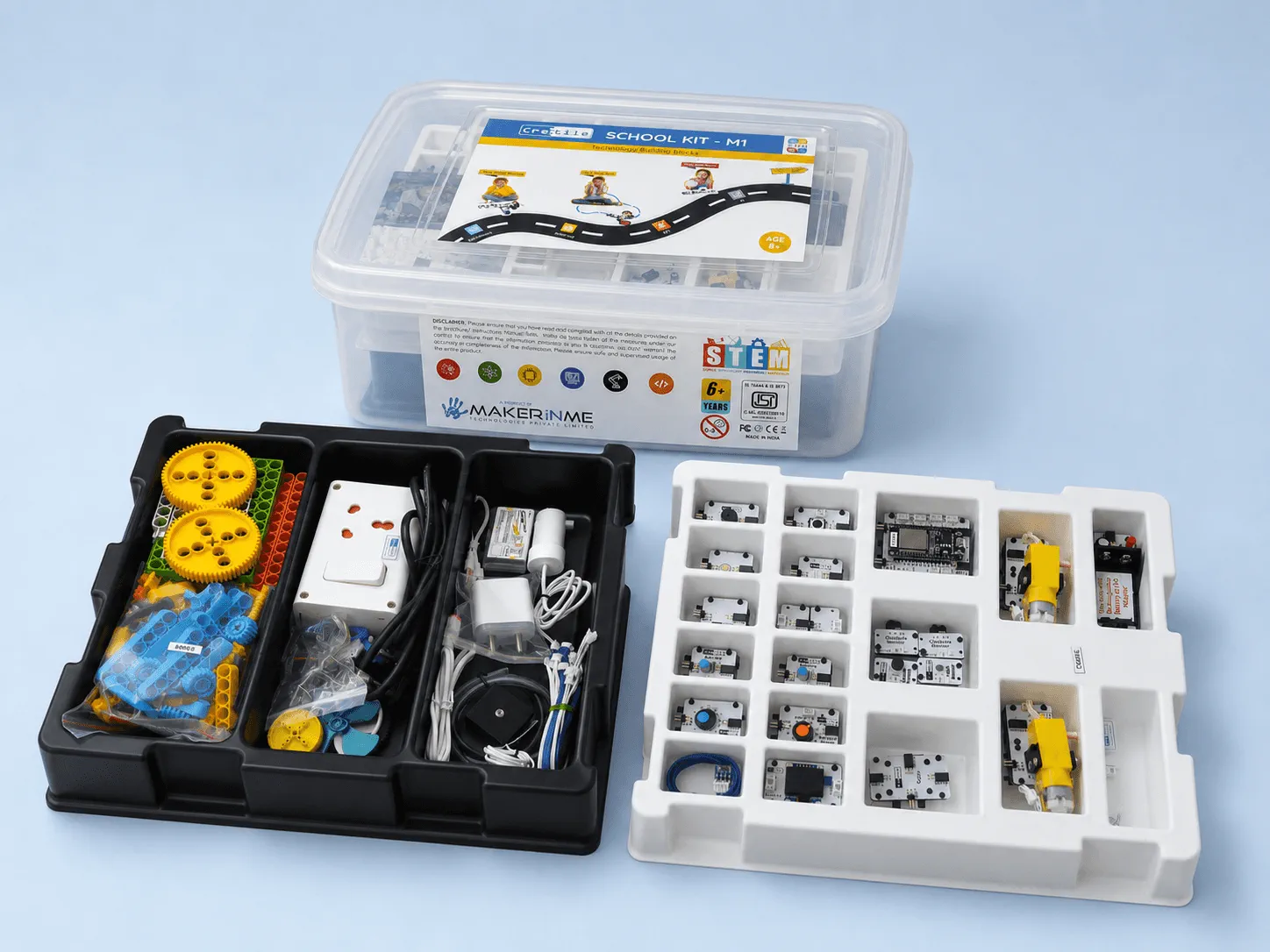
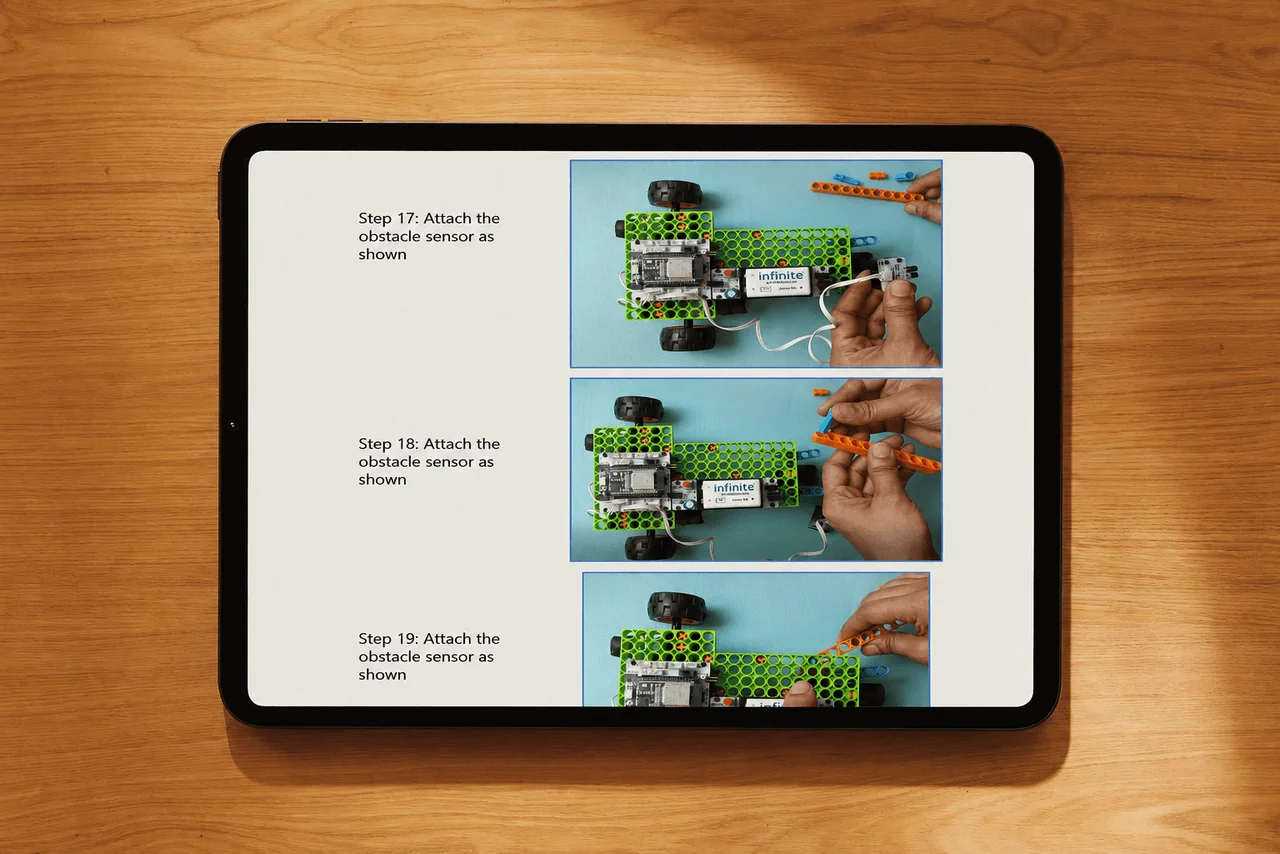
An example from our own range. The Mini School kit covers Grades 4 to 10 with 144 projects in six courses of 24, one course each for Grades 4 to 8 and one shared by Grades 9 and 10. Each course has video lessons. A school also gets lifetime access to the learning platform (LMS), with a session plan, slides, guide, video and quiz for every project. Teachers are trained through our partners: we train their trainers, and they train the teachers in each school. Every part is reusable year after year.
Watch for: a quote that lists only hardware. Ask the supplier which project fills which period, and who trains the teachers.
What do students do in a STEM lab period?
In one 40-minute period, students hear what they're building and why, build and test it, then find what went wrong, fix it, and talk about it. Roughly:
| Minutes |
What happens |
| 0 to 15 |
The teacher introduces the project and the idea behind it |
| 15 to 30 |
Students build and test in small groups |
| 30 to 40 |
They find errors, fix them, and reflect on why it works |
It varies by project. What matters is that the last 10 minutes are protected. "It works" is not the same as "I understand why it works", and that understanding forms in the fixing.
The same project can also grow with the grade. Here's the water level alarm again:
- Grade 4: built with no code. A sensor and a buzzer, and the logic lives in the circuit. The question is "does it work?"
- Grade 5: a condition is added, so the student decides when the buzzer sounds. "Can I control when it works?"
- Grade 7: it becomes an IoT (internet of things) project, and the alert reaches a phone. "Can someone across the room know it's working?"
The hardware stays the same. The question the student answers changes.
Does the new CBSE AI curriculum change what a STEM lab needs?
CBSE's Computational Thinking (CT) and Artificial Intelligence (AI) curriculum applies to Classes 3 to 8 from the 2026-27 session (Circular Acad-15/2026, 1 April 2026). CBSE says it doesn't depend on any particular platform, so no kit is required to teach it. Schools can choose the platform they use for projects (CBSE's CT and AI curriculum framework).
So a STEM lab is not compulsory for the new curriculum. What a lab does is give students something real to apply the thinking to. Breaking a problem down, spotting a pattern and fixing a fault are easier to learn on a circuit that fails in front of you than on a worksheet.
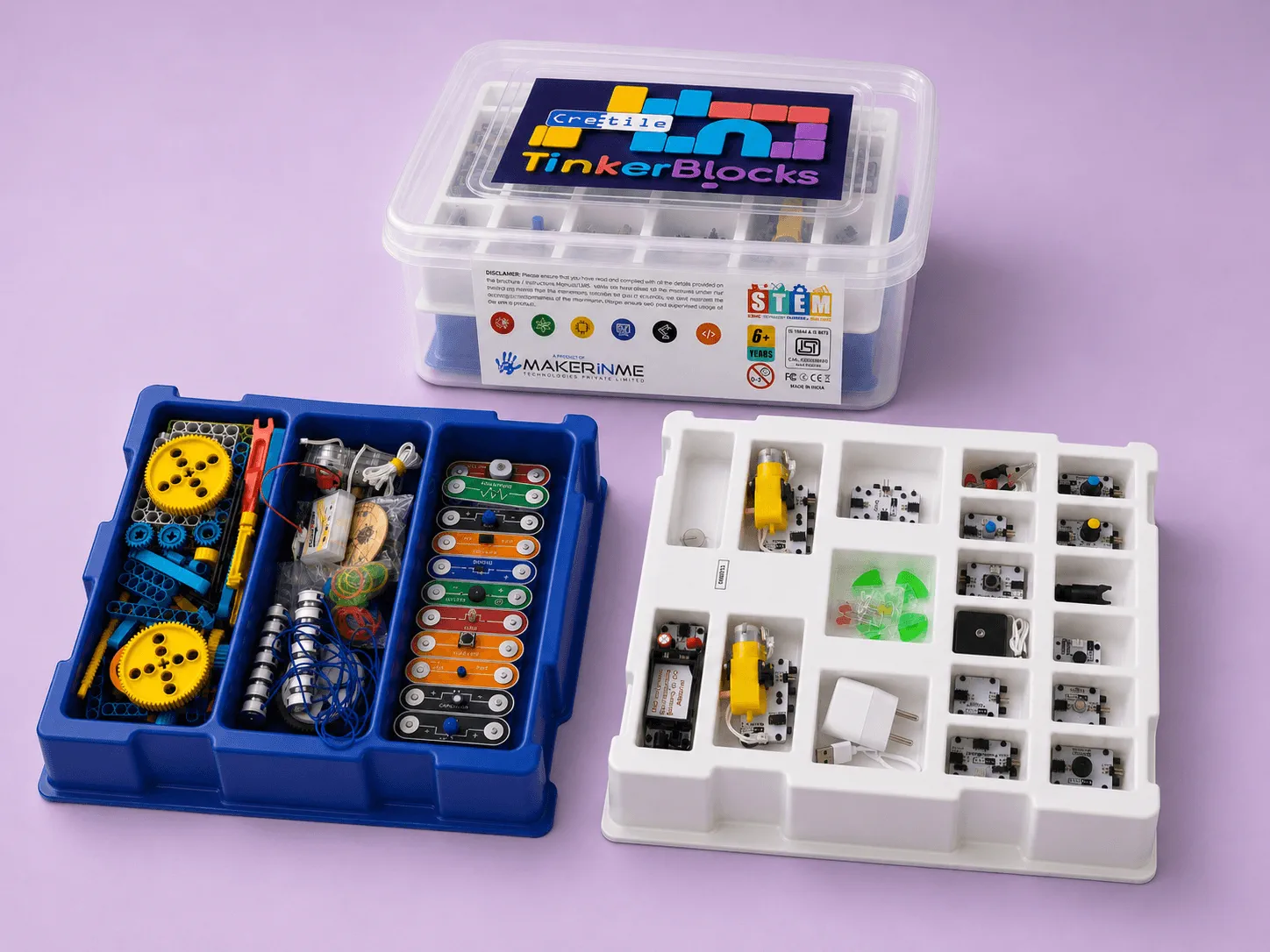
Screens don't have to come first. TinkerBlock, for Grades 1 to 3, has 75 projects with no coding and no screens. In our programme, coding starts in Grade 4, on a computer in the browser, and grows into app development and Python in the higher grades.
Why do STEM labs go quiet, and what keeps one running?
STEM labs go quiet when the kits arrive without a timetable slot, a curriculum or trained teachers. They stay in use when teachers who don't come from a technical background feel confident running a session on their own.
Three things usually go wrong:
- No slot on the timetable. If the lab has no fixed period, it gets used when there's spare time, which is never.
- No lesson for next week. Teachers can't invent a new project every week on top of their syllabus.
- Equipment that needs an expert. If a loose wire or a code error stops the class, teachers stop opening the box. Teachers shouldn't have to become engineers to run a lab.
In Wardha, we trained Zilla Parishad school teachers and then watched them guide their own students through robotics projects. That's the test of a STEM lab: sessions that keep running after the supplier has left.
Where we're not the right fit: children under 6. Our block kits start at Grade 1.
Who this is for
You're a school principal. Your budget is set between December and March, and the lab has to be in use from the first week of April. Ask for training before the first class and a curriculum that fills your timetable. A room full of kits without those two is a cost, not a lab.
You're running an EdTech STEM programme. Your renewals depend on teachers in many schools actually running sessions. You need a curriculum mapped to periods and training you can pass on. That's how we work with partners: we train your trainers, and they train the teachers in your schools. Whitelabelling is available.
You're a CSR or NGO programme lead. You need outcomes you can report, often in schools without a computer lab. Look for kits that work without screens in the early grades and teacher training that continues after the first visit. Wardha is the model we'd point you to.
You're setting up an Atal Tinkering Lab. You buy against the Atal Innovation Mission's equipment list, usually through GeM. Check that your supplier is a certified OEM for the categories you need.
The labs side by side
| Lab |
What students do |
Who asks for it |
Typical equipment |
| STEM lab |
Design, build, test and fix |
The school itself |
Building kits, sensors, motors, a curriculum |
| Science lab |
Confirm a known result |
The board syllabus |
Glassware, chemicals, specimens |
| Atal Tinkering Lab |
Tinker and prototype |
AIM, NITI Aayog (for selected schools) |
Equipment from the ATL package list |
| Composite Skill Lab |
Learn skill subjects by doing |
CBSE, every affiliated school by 22 Aug 2027 |
Tools for at least three skill subjects |
| Robotics lab |
Build and code robots |
The school itself |
Robotics kits, computers from the middle grades |
| Maths lab |
Explore maths concepts with objects |
The board syllabus |
Manipulatives and models |
FAQ
What is a STEM lab in a school?
A STEM lab is a space, or a set of kits, where students learn science, technology, engineering and maths by building things that work and fixing them when they don't. It differs from a science lab, where students confirm a known result.
What's the difference between a STEM lab and an Atal Tinkering Lab?
A STEM lab is the general idea. An Atal Tinkering Lab (ATL) is a specific scheme of the Atal Innovation Mission, NITI Aayog, where selected schools get a grant and buy equipment against a set package list.
Is a STEM lab mandatory for CBSE schools?
No. What CBSE does require is a Composite Skill Lab, which every affiliated school must set up by 22 August 2027. A STEM lab doesn't count as one. See our Composite Skill Lab requirements guide.
Do students need computers in a STEM lab?
Not in the early grades. Kits like TinkerBlock work with no screens or coding for Grades 1 to 3. In our programme, coding starts in Grade 4, on a computer.
What should a STEM lab include?
Reusable kits, a curriculum that maps a project to each period, a platform with lessons and guides, and trained teachers. Without the last three, the kits tend to stay in the cupboard.
How much does a STEM lab cost?
It depends on the grades, the number of students and how many kits each class shares. Tell us your grades and class sizes, and we'll connect you with the Cretile partner nearest you for a quote.
Get started
Send us your grades, class sizes and how many periods a week the lab can have. We'll suggest a kit mix and connect you with the Cretile partner nearest you.
Not sure yet? Order one kit with full LMS access and use it for 8 weeks. If it isn't right for your school, we arrange the pickup and a full refund.
Talk to us
Sources